Considering nasolabial fold filler in houston? Start with a consultation.
Book Consultation(opens in a new tab)What it treats
- Nasolabial folds (the nose-to-mouth-corner lines)
- Smile lines and laugh lines that stay visible at rest
- Mid-face flattening that deepens the fold from above
- Asymmetry where one fold reads deeper than the other
- Early volume loss around the mouth and mid-cheek
Products used in this treatment: Restylane Defyne, Evolysse Smooth
Why the fold deepens in the first place
The nasolabial fold is not really a line that forms in your skin the way a scratch forms on a table. It is a boundary. On one side you have the fuller tissue of your cheek, on the other side the flatter tissue around your mouth. As we age, the mid-face loses volume and the fat pads there descend a little. The cheek deflates and slides. That pushes tissue down toward the fold and makes the crease look deeper, even though nothing dramatic happened at the fold itself.
A quick clinical aside. The cheek fat pads sit on bone that also changes shape over time, and the maxilla can lose projection with age. That is part of why a fold that was a faint line at 30 can read as a deep groove at 50. It is a stack of changes, not one thing.
This matters for treatment. If the fold is being driven from above by a deflating cheek, filling the fold directly only chases the symptom. The cause is higher up.
My treat-the-cause-first approach
When a patient comes in asking for smile line filler, the first thing I do is have them smile, talk, and rest while I watch the mid-face. I am looking at where the volume actually sits and where it has gone. In a lot of cases I will recommend supporting the cheek first and then reassessing the fold, rather than going straight at the crease.
Why. Over-filling the fold itself tends to look heavy and unnatural - it can give a puffy, shelf-like ridge alongside the nose that nobody asks for. Lifting and supporting from the cheek often softens the fold from above and keeps the lower face looking like a face, not a filled-in mask. If you want to read more about that side of things, I cover it on my cheek filler page.
Sometimes the answer is both - a little cheek support and a conservative amount placed deep along the fold. Sometimes it is cheek only. I would rather under-treat and have you come back than overdo it and have to dissolve.
Product choice: Restylane Defyne and Evolysse Smooth
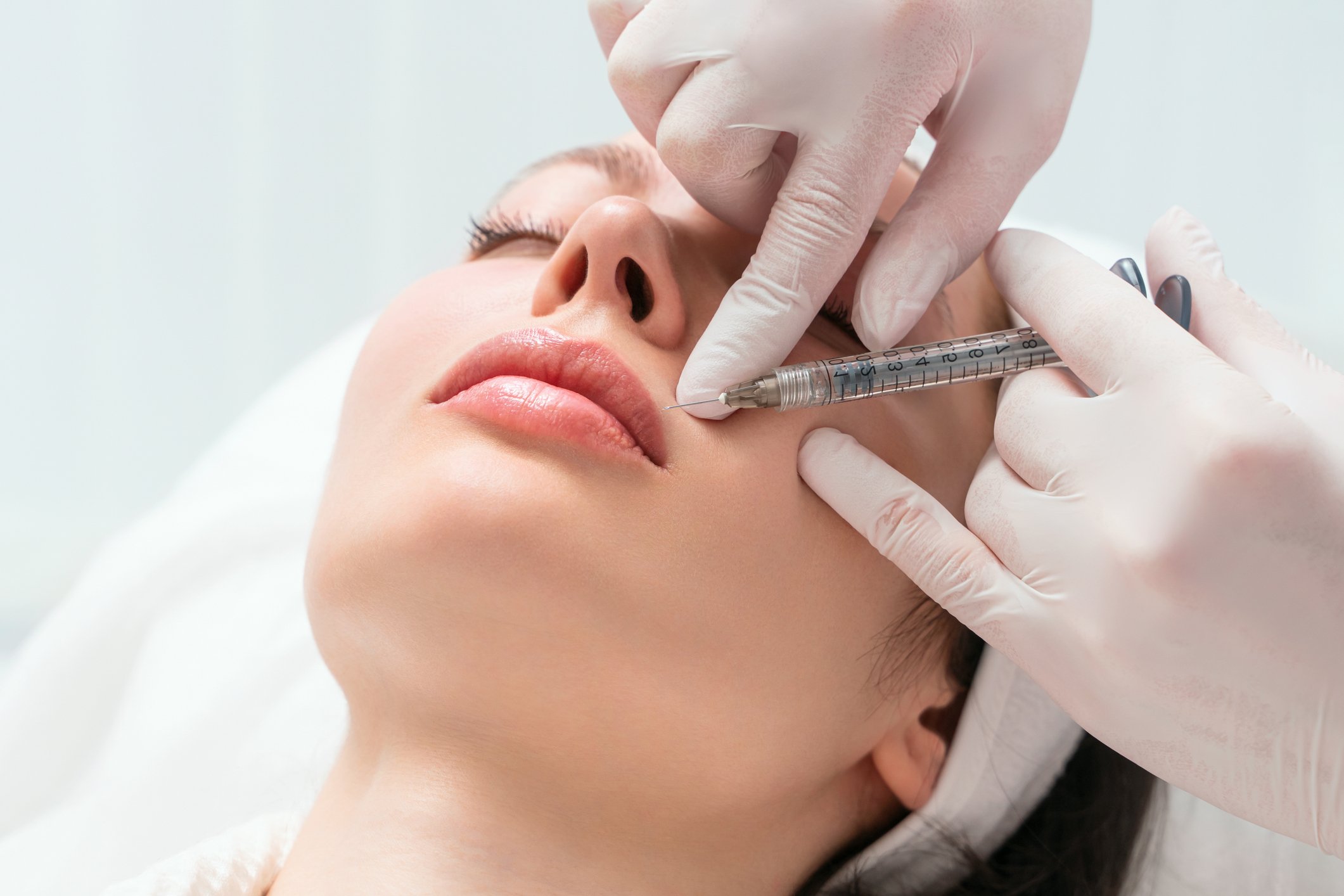
For the nasolabial folds I most often reach for Restylane Defyne or Evolysse Smooth. Restylane Defyne is FDA-approved for correction of moderate to severe deep facial wrinkles and folds, such as the nasolabial folds, and it is built to flex with expression rather than sit stiff in an area that moves every time you talk. Evolysse Smooth is a newer hyaluronic acid filler I like for soft integration into the tissue, so the result settles in smoothly instead of feeling like a separate ridge under the skin.
Both are hyaluronic acid fillers, which is the family of fillers that can be dissolved with hyaluronidase if we ever need to adjust or remove the product. That reversibility is one reason I prefer HA for this area, where placement and motion both matter.
What is realistic: soften, not erase
Let me set expectations clearly. The goal here is to soften the fold, not to erase it. A nasolabial fold that disappears completely usually means the area was overfilled, and that reads as fake. I am aiming to take the depth down a notch or two so you look rested, not to flatten a normal facial contour that everyone has to some degree.
On timing - with HA filler you see most of the change right away, then swelling settles over the next one to two weeks. The result looks its truest around the two-week mark, which is when I like to see you back to check it. Some patients need a small top-up at that visit. That is normal and expected, not a failure.
How long it lasts depends on the product, how much we used, and your own metabolism. As a general range, HA fillers in this area tend to last somewhere around a year for many patients, sometimes longer, sometimes less. I cannot promise a number. Anyone who guarantees you an exact duration is guessing.
When Sculptra is the better long game
For some patients, the real issue is global volume loss across the whole mid-face, not a single fold. In those cases a biostimulator like Sculptra can be a better long-term play. Sculptra works differently from HA filler - instead of adding instant volume in one spot, it stimulates your own collagen gradually over a series of sessions, which can restore support more broadly and softly.
The trade-off is patience. Sculptra results build over months and usually take a few sessions, so it is not the answer if you want a visible change next week. But for diffuse mid-face deflation it can age more gracefully than chasing the fold with HA every year. I go deeper into that on my Sculptra page, and we can talk through which path fits you at your visit.
Pricing, downtime, and Houston logistics
On cost - I quote at the consultation rather than posting a flat price, because the right plan ranges from a small amount along the fold to cheek support to a Sculptra series. Pricing this area honestly means seeing your face first. I would rather give you a real number tied to a real plan than a teaser that changes once you are in the room.
Downtime is usually mild. Expect possible bruising, swelling, or tenderness for a few days. Bruising near the mouth and folds does happen because the area has a good blood supply, so I tell patients to leave a buffer before a big event. I work under the medical direction of Danna Qunibi, MD, and I will walk you through aftercare and what to watch for before you leave.
We are at 2401 N. Shepherd Dr., Suite 229, at 24th and Shepherd in the Houston Heights, just south of I-610. Parking is free under the building, so you are not feeding a meter or circling the block - you pull in, park underneath, and come up. Easy in and out from Garden Oaks, the Heights, and the rest of the inner-loop northwest side.