
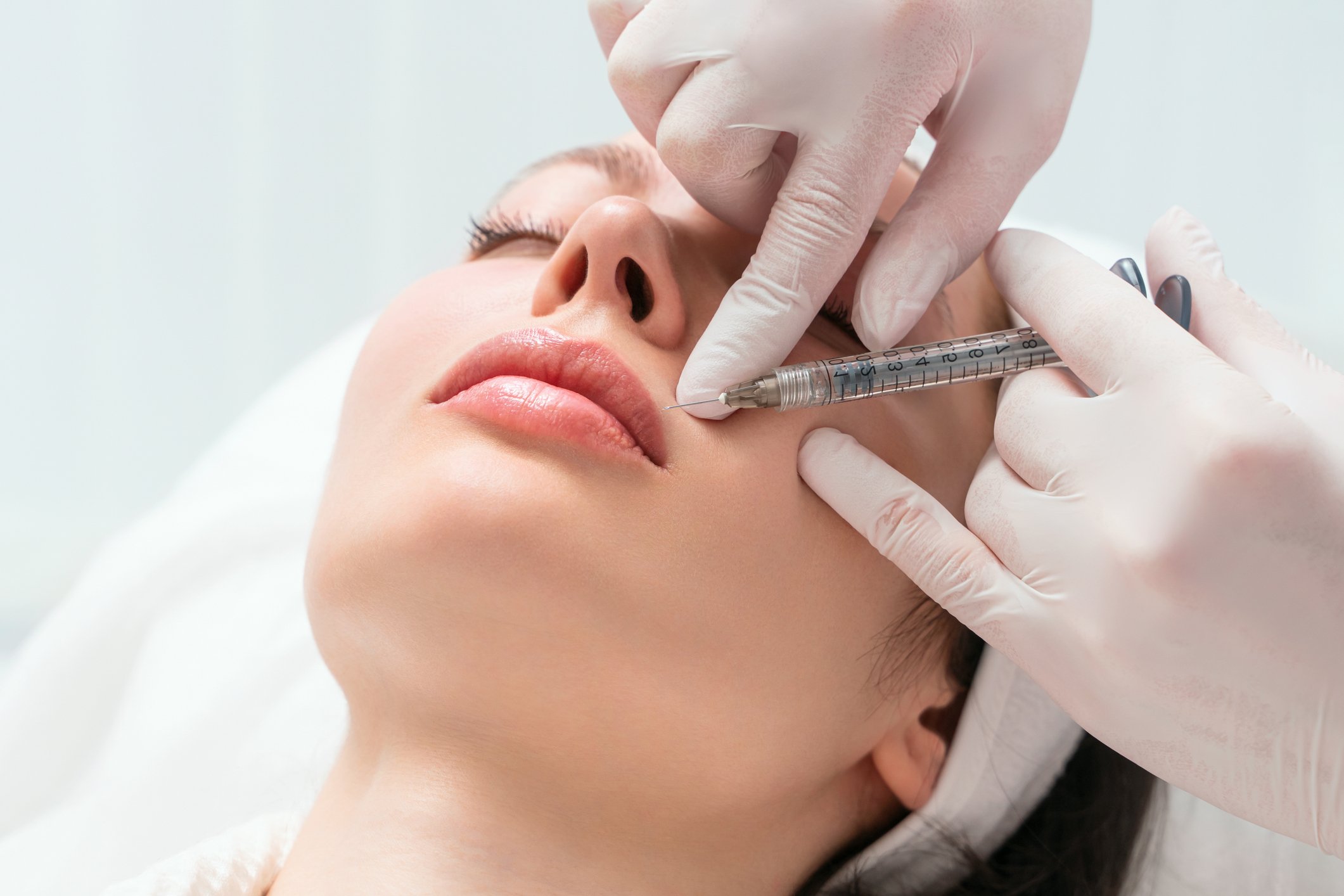
Considering under-eye filler in houston? Start with a consultation.
Book Consultation(opens in a new tab)What it treats
- True infraorbital hollowing with good skin quality
- A defined groove between the lower lid and the cheek (the tear trough)
- A tired, sunken look from genetic volume loss under the eye
- Mild dark shadowing that is caused by the hollow casting a shadow
- Lower-lid hollows that pair with a flat or descending cheek
Products used in this treatment: Restylane Eyelight
Who this actually works for - and who it does not
Good candidates have one thing in common: a true hollow with skin that is still in decent shape. If you have a clear groove under the eye, minimal puffiness, and skin that is not heavily crepey or discolored, you are the person filler tends to help. Younger patients with a genetic tear trough usually do beautifully because the tissue quality is on our side.
Now the harder conversation. Poor candidates show up with prominent fat-pad bulging - the little pillows of fat that push forward and sit above a hollow. Filler under a bulge does not erase the bulge. It can make the whole lower lid look more swollen. The same goes for festoons and malar edema, which is fluid and lax tissue sitting on the cheekbone. Put hydrophilic filler near tissue that already holds fluid and you can make the puffiness worse, sometimes for a long time.
Very thin, dark, crepey skin is its own caution. Filler does not fix skin texture or pigment, and placed too shallow it can throw a bluish cast (the Tyndall effect) that reads as a new shadow. If your main complaint is the color of the under-eye rather than the depth, filler is the wrong tool. That is usually a skin-quality conversation, and I will point you toward Lite-Eyes microneedling instead.
Why I often treat the cheek first - or instead
Here is the clinical reality most people are not told. A large share of under-eye hollowing is not really an under-eye problem. It is a mid-face support problem. When the cheek deflates and drifts down with age, the tear trough deepens because the structure underneath it has dropped away. The shadow you see at the lid is the top edge of a cheek that has lost its scaffold.
So at the consult I look at the whole mid-face, not just the groove. In a fair number of cases I will treat the cheek first, restore that support, and then we re-check the trough at the two-week mark. Often the hollow improves on its own once the cheek is holding things up, and we either need far less product in the trough or none at all. I would guess I end up treating the cheek before, or instead of, the trough in a meaningful fraction of the people who come in asking only about their under-eyes. If that is you, cheek filler is the better first step.
Restylane Eyelight and why product choice matters here
Eyelight is FDA-approved for correction of infraorbital hollows - the under-eye - in adults. That approval matters because it means the product was studied in this exact location. It is a hyaluronic acid gel formulated to hold less water and integrate cleanly in thin skin, which is the opposite of what you want from a plumping lip filler in this spot.
The wrong filler under the eye is one of the most common reasons people come to me unhappy from somewhere else. A product that draws too much water can leave you puffy. Placed too superficially, you get that bluish Tyndall hue. Like every HA filler, Eyelight is dissolvable with hyaluronidase, so a poor result is correctable - but I would much rather get the candidate selection and depth right the first time than rely on a reversal.
The appointment, onset, and how long it lasts
A tear trough appointment runs about 45 to 60 minutes including a proper look at your mid-face. I numb topically, and the product contains lidocaine. Most people describe pressure with a few sharper moments. I tend to use a cannula in this area when I can, which can lower the bruising risk compared with a needle, though it does not eliminate it.
You will see an initial change right away, but the honest read comes at two weeks once any swelling settles. I almost always book a two-week follow-up here because this area can hold a little fluid early and I want to see the true result before deciding whether to add anything. Longevity under the eye is often longer than other areas precisely because the tissue moves less - many patients get a year or more, and some hold even longer. I will give you a specific expectation for your anatomy at the consult rather than a blanket number.
Downtime, risks, and the honest limits
Plan for bruising and some swelling for several days. This area bruises more readily than most, so if you have a wedding or a shoot, give yourself at least two weeks of runway. Puffiness, especially morning puffiness for the first week or two, is common as the tissue adjusts to the product. Less common but real risks include prolonged fluid retention, the Tyndall hue if product sits too shallow, lumps, and the rare but serious vascular complications that come with any facial injection. We review all of this before you decide.
The limits, stated plainly: filler treats depth, not skin texture, not pigment, and not bags. If your concern is dark circles from thin discolored skin, Lite-Eyes is the better match. If your concern is fat pads or true bags, that is a surgical conversation and I will tell you so. I am happy to lose the booking if the honest answer is that filler will not get you where you want to be.
Pricing and getting here in Houston
I price under-eye treatment at the consult, after I have seen your anatomy and we have agreed on a plan - including whether the cheek comes first, which changes the math. Tear trough work usually takes less product than a cheek or a set of lips, but I will not quote a number sight unseen because the right plan varies so much person to person. You will have a clear total before anything is injected.
We are at 2401 N. Shepherd Dr., Ste. 229, at 24th and Shepherd in the Houston Heights, just south of I-610. There is free parking under the building, so you are not hunting for a spot before an appointment where I would rather you arrive relaxed. It is an easy drive from the Heights, Garden Oaks, the Greater Heights, and the inner-Loop neighborhoods nearby.